Astrobotic Technology, Inc.
Created: 2026-04-06 (session 46)
Source: TechPort query find_projects(query="Astrobotic", status=null) → 57 projects (2026-04-04 cache)
Summary
Astrobotic (Pittsburgh, PA) is NASA's most active commercial partner for lunar surface infrastructure in TechPort — 57 projects spanning 2010–present. The portfolio covers every major subsystem a commercial lunar lander needs: precision navigation, hazard avoidance, surface mobility, power distribution, ISRU excavation, and comms. This is not a single-program relationship; it's a multi-decade technology co-investment built through SBIR/STTR phases feeding GCD "Tipping Point" flight demos.
Project count by program:
| Program | Count | Key projects |
|---|---|---|
| SBIR/STTR | ~35 | Core technology development contracts |
| GCD | ~8 | Industry-led Tipping Point flight demos |
| FO | ~3 | LiDAR hazard detection, landing guidance |
| STRG | 1 | Partner on U Washington DTN routing |
| MCO | 1 | Lunar CATALYST precursor (2014) |
Technology Clusters
1. Landing Navigation (TRN + Hazard Avoidance)
The most mature cluster. Astrobotic built an end-to-end precision landing capability through NASA co-investment:
TRN — Terrain Relative Navigation: - 116335: GCD, TRL 9 (completed 2024). Passive-optical TRN + Visual Velocimetry sensor. 2.5 kg, 15W peak. Partners: Moog Space and Defense, Moog Broad Reach, JPL, JSC. Flew on Peregrine Mission One (Jan 2024). - Target was TRL 7 (from flight demo); recorded TRL 9. Note: Peregrine Mission One failed due to a propulsion leak and never landed. TRL 9 requires "actual system proven through successful mission operations." The sensor operated in space (potentially justifying TRL 7–8), but a full successful landing was not achieved. This is a candidate for TRL inflation — or NASA applied the "technology operated successfully" criterion independent of mission outcome. Confidence: speculative.
Autolanding System:
- 93996: FO, TRL 4→6 (completed 2016). Early autolanding for GPS-denied planetary landing. Pre-dates TRN work.
LiDAR Hazard Detection: - 106719: FO, Active, TRL 4→7, ends Jul 2026. LiDAR system for rock/crater/slope detection during powered descent. Partners: planning to fly on Astrobotic lander. Views: 3473 — high visibility. - 158335: SBIR, TRL 3→4, completed. RASTR ultra-fast smart LiDAR.
Visual Relative Navigation: - 103134: SBIR, TRL 4→6 (completed 2022). UltraNav: visual relative navigation for TRN/SLAM. - 102058: SBIR, TRL 3→4 (completed 2020). Phase I precursor.
2. Surface Mobility (CubeRover Platform)
CubeRover is Astrobotic's small rover platform — a standardized form factor for lunar surface operations. Multiple TechPort entries trace its development:
| Project | Program | TRL | Period | What |
|---|---|---|---|---|
| 10300 | SBIR | 2→3 | 2010-2011 | Scalable Gravity Offload System — early test infrastructure |
| 113157 | SBIR | 2→6 | 2021-2022 | CubeRover for Lunar Science — Phase II SBIR that led to GCD Tipping Point award ($1.96M) |
| 116386 | GCD | 4→6 | 2020-2022 | CubeRover GCD — ARC-led, brought platform to TRL 6 (hardware demo) |
| 154823 | SBIR | 4→4 | 2022-2025 | Lunar Night Survival Phase II — development ended TRL 4 (flight demo still pending) |
| 154324 | SBIR | 4→4 | 2022-2025 | Lunar Night Survival Phase I — concurrent with Phase II |
| 184640 | GCD | 4→9 | 2022-Dec 2026 | Lunar Night Survival GCD — active; flight demo oversight (see below) |
Lunar Night Survival (184640) — the capstone CubeRover project:
Four technologies to be demonstrated on Astrobotic's next polar lander mission (target Dec 2026): 1. First commercial mobility-as-a-service on the Moon — business model demonstration 2. Ultra-compact RHU (Radioisotope Heater Unit) — 2U payload for 14-day lunar night survival (-180°C) without large batteries or active heating 3. Long-range Software-Defined Radio (SDR) — rover-to-orbital asset comms, several km range, high-bandwidth 4. First lunar in-situ mobility testing — trafficability data for lightweight robots
PI: Cedric Corpa de la Fuente / Michael Provenzano (Astrobotic). NASA PM: Matthew C. Deans (ARC).
TRL currently 5 (as of 2026-03-23). Was 4 at SBIR Phase II completion (Dec 2025). TRL 5→9 requires the polar lander mission to launch and succeed by Dec 2026 — extremely aggressive timeline given Peregrine's Jan 2024 failure.
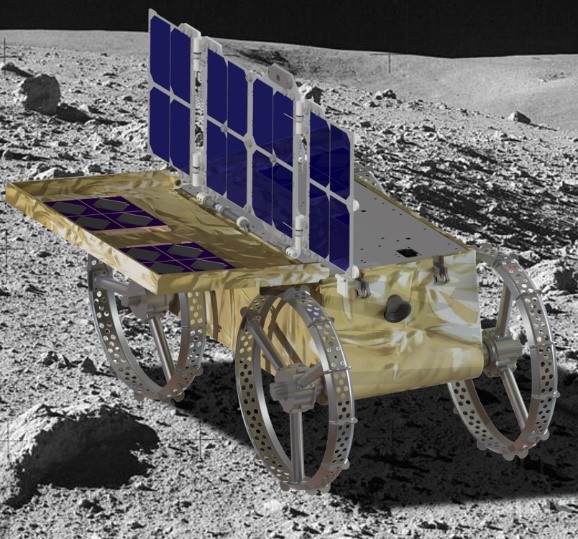
Astrobotic CubeRover concept for Lunar Night Survival demo. Solar panels deployed, RHU and SDR integrated as 1U payload. From SBIR briefing chart (fileId 384894).
3. Lunar Power Distribution (LunaGrid Ecosystem)
Astrobotic is developing LunaGrid — a commercial lunar power utility — with NASA GCD and SBIR co-investment:
LunaGrid-Lite (147018) — GCD Tipping Point: - Industry-led GCD project, TRL 4→7, 2023–Jul 2028 - Develop and fly high-voltage cable + converter + cable reel to demonstrate 1kW power distribution at 100–500m on the lunar surface - PM: Soravud "Joe" Piboontum (GRC). Program: Werkheiser/Thornblom. - "As early as 2026" for flight on Astrobotic commercial lander - TRL still 4 as of 2026-04-04 — in ground development - Technology base: feeds from JPL TYMPO [116287] and GRC UMIC [184614] power conversion work
VSAT — Vertical Solar Array Technology: - 184667: LaRC testing Astrobotic's VSAT, TRL already at 6 vs target 5 — exceeded - 158102: SBIR TRL 2→4 (VSAT-XL Phase I, completed)
Cable technology pipeline: - 154764: SBIR, TRL 3→6 (completed). Low mass, high voltage cables for lunar power distribution. - 158548: SBIR, TRL 4→6, active through Jun 2026 (Phase II refinement) - 116292: GCD, TRL 4→6 (completed). Ultra Fast Proximity Charging (WiBotic magnetic resonance, with U Washington)
Wireless power: - 113261 + 102737: SBIR, TRL 1→5. High Power Near-Field Wireless Transfer for dust-intensive environments.
4. ISRU & Excavation
ISRU Pilot Excavator (116320): - GCD, TRL 4→6, 2024–Apr 2027. Lunar regolith excavation system for ISRU feedstock delivery. - Direct complement to Blue Alchemist (146991) — Blue Origin's in-situ solar cell fab needs regolith supply.
5. Navigation, Computing, and Supporting Technologies
Software Defined Reliability: - 94164: GCD, TRL 4→6 (completed 2019). GSFC-led, radiation-tolerant software for high-throughput computing under SEEs. - 94755: SBIR, TRL 3→4 (completed 2019). Phase I component. - 158108: SBIR, TRL 1→3 (completed 2025). ASICS — AI/ML on space computing.
Swarm / Distributed Localization: - 125498 + 158512: SBIR, TRL 2→3 and 3→5. DALEC distributed localization for rover swarms (UWB + VIO fusion).
RPOD and In-Space Navigation: - 125604 + 113317: SBIR, TRL 3→5 and 3→4. LiDAR-based RPOD navigation. - 103134: SBIR, TRL 4→6. UltraNav visual relative nav.
Plume-Surface Interactions (PSI): - 154625: SBIR, TRL 1→4. PSICHIC combined high-speed/thermal/event camera for PSI imaging. - 154538 + 158675: SBIR, TRL 1→4 and 4→6. Floatinator: low-gravity PSI test simulator. Active through Jul 2026.
The GCD Tipping Point Structure
Several Astrobotic GCD projects follow a distinct Tipping Point pattern:
| Project | Lead | Structure |
|---|---|---|
| TRN [116335] | Astrobotic (industry) | Industry lead, NASA center (JPL/JSC) as consultants |
| LunaGrid-Lite [147018] | Astrobotic (industry) | Industry lead, GRC oversight |
| CubeRover [116386] | ARC (NASA center) | Center lead, Astrobotic commercial partner |
| Lunar Night Survival [184640] | ARC (NASA center) | Center lead, Astrobotic commercial partner |
Two distinct GCD modes: - Industry-led Tipping Point: Astrobotic leads, NASA provides technical expertise; clear commercial product target (TRN sensor, LunaGrid utility) - Center-led commercial partner: NASA center (ARC) manages, Astrobotic does the technical work; technology demo on Astrobotic mission
Both modes lead to CLPS flight demos. The distinction matters for IP ownership and post-project commercialization.
Lineage: From Lunar CATALYST to CLPS
32426 Lunar CATALYST (MCO, 2014-2019, TRL 4→8): NASA HQ-led program encouraging commercial lunar landers. Three partners: Astrobotic, Moon Express, Masten Space. No cost contracts; NASA provided technical assistance and test facilities. Outcome: 1 transition (to CLPS). Views: 1101.
This was the origin of the NASA-Astrobotic relationship — a NASA initiative that incubated Astrobotic's lander from early technology into a product. CLPS (2018+) is the procurement evolution of Lunar CATALYST.
Active Projects (April 2026)
| Project | Program | TRL | End | What |
|---|---|---|---|---|
| Lunar Night Survival | GCD | 5→9 | Dec 2026 | CubeRover flight demo (RHU+SDR) |
| LunaGrid-Lite | GCD | 4→7 | Jul 2028 | 1kW cable power distribution |
| ISRU Pilot Excavator | GCD | 4→6 | Apr 2027 | Regolith excavation system |
| LiDAR Hazard Detection | FO | 4→7 | Jul 2026 | Hazard avoidance LiDAR |
| Low Mass HV Cables | SBIR | 4→6 | Jun 2026 | Power cable Phase II |
| Floatinator (PSI) | SBIR | 4→6 | Jul 2026 | Low-gravity PSI simulator |
| Modeling PSI | SBIR | 4→6 | Jun 2026 | Computational PSI software |
| DALEC swarm nav | SBIR | 3→5 | Jan 2026 | Distributed rover localization |
Key Observations
-
Breadth is exceptional: 57 projects across landing nav, mobility, power, ISRU, comms, computing — Astrobotic has used NASA R&D funding to build a complete lunar lander technology stack.
-
The TRN TRL 9 case: TRL 9 after a failed mission is ambiguous. Either NASA assessed the sensor's in-space performance as sufficient for TRL 9, or this is an inflation case. The sensor reportedly operated correctly in space even as Peregrine's propulsion failed — but a landed mission is the intended operational environment for precision landing technology. Worth watching for community discussion.
-
LunaGrid as commercial strategy: Astrobotic is positioning LunaGrid as a commercial power utility — selling power to NASA and other CLPS customers on their landers. The cable, connector, VSAT, and LunaGrid-Lite TechPort entries represent R&D co-investment building toward a commercial product.
-
Multiple CLPS flight demos planned: Three GCD active projects culminate in Astrobotic CLPS flights — Lunar Night Survival (polar, ~2026), LunaGrid-Lite (commercial lander, ~2026-2028), LiDAR Hazard Detection (FO, ~2026). If all proceed, Astrobotic's next polar lander will be among the most technology-dense CLPS missions.
-
SBIR pipeline depth: ~35 SBIR entries show Astrobotic's sustained participation in NASA's early-stage program. Many are Phase I/II combinations (same title, successive IDs). The SBIR pipeline feeds GCD Tipping Point awards at TRL 4-5.
Open Threads
- TRN TRL 9 claim: Did the sensor perform on Peregrine? Is TRL 9 justified? No document in TechPort. Would require external sources.
- Lunar Night Survival flight date: Astrobotic's "next polar lander" — is this CP-6 or a different task order? What is the current launch schedule? TRL 5→9 by Dec 2026 requires flight this year.
- LunaGrid-Lite 2026 target: "As early as 2026" is in the project description. What mission is this flying on? Astrobotic Griffin (CP-2/VIPER replacement)?
- ISRU Pilot Excavator closeout: What TRL will this reach? Does it connect to Blue Alchemist's regolith supply needs?
Queries Used
find_projects(query="Astrobotic", status=null)→ 57 projects (2026-04-04 cache)get_project([147018, 116335, 154823])batch — LunaGrid-Lite, TRN (TRL 9), Lunar Night Survival SBIRget_project(116335)live — TRN full details (TRL 9, Closed_Out Oct 2024)get_document(384893)— SBIR Lunar Night Survival briefing chart (tech details, CubeRover image)get_document(384894)— CubeRover image (JPEG)
Related Pages
- topics/tx04-robotics-autonomy.md — CubeRover and Lunar Night Survival in GCD portfolio context
- topics/gcd-active-portfolio.md — LunaGrid-Lite, VSAT, ISRU Excavator in GCD active
- topics/tx09-edl.md — TRN is precision landing technology (TX09.5)
- topics/tx03-sbir-power.md — Power context for LunaGrid
- programs/gcd.md — GCD program profile